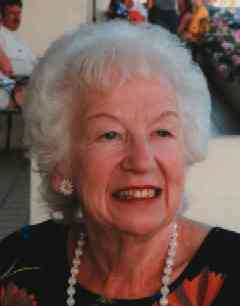
Elizabeth Romain:
She was born in Wimbledon, England November 3rd. Her dance career began at an early age when her Mother took her to dancing lessons when she was two years old. Later she was in a well known Juvenile Dance Trope called “Terry’s Juvenile” and was in various Pantomimes with them.
| She began teaching dance at the young age of 14. She had her own little studio in North Cheam. She was an ISTD Examiner for over 30 years and was known all over the world for her training methods in preparing candidates for their exams. She trained endless numbers of professionals including Top Competitors and World Champions. She had a tremendous background in dance having been an accomplished dancer and teacher in ballet, tap and musical comedy before her interest turned to Ballroom Dancing during World War II. She received many awards both nationally and internationally. In 2002 she was given a special Achievement Award by the USISTD and was also elected to the Worlds Dancing Hall of Fame, USA. She received the Carl Alan Teachers’ Award 1973 and the Imperial Award in 1990 to name a few. |
|
For many years she worked with the late great Alex Moore at the Zeeta Dance Studios in Kingston-on-Thames, England. Elizabeth liked to refer to the studio as the League of Nations of Ballroom Dancing, as people came from all over the world to train for their Professional Exams. This experience of working with Alex contributed to her incredible understanding of the theoretical study of dance and her complete knowledge and understanding of the Revised Technique by Alex Moore. She not only knew what, but more importantly she knew “why”. She used to have a little saying; “be wise to the whys”
She was a member of the ISTD Latin American Faculty Committee for 32 years until 2000 and was Chairperson for the last two of those years. During that time she was in no small way responsible for the production of both the original ISTD Revised Technique of Latin American Dancing and that of our wonderful present day books. Her brilliant mind combined with her dance background, tenacity, attention to detail and the appreciation of consistency of language, she made an invaluable contribution to the theoretical language we enjoy in our current books.
She travelled all over the world examining, giving training and seminars. This included many trips to the United States. Many teachers from all over the world feel gratitude and warmth towards Liz for the contribution she gave in furthering their understanding of theoretical training. Teachers in Japan had an endearing nickname for Liz – Madame Dictionary. The reason for this nickname was her ability to answer any technical questions relating to Latin American and Ballroom theory without hesitation, in an easy to understand way.
We will all miss her greatly but I feel happy in knowing that her life’s work and devotion to dance was not in vain as she has inspired so many people all over the world. She played an important part in my life and the lives of countless others. We are eternally grateful and we will miss her.
By Lori Woods-Gay
Written by Wayne Crowder Feb 08, 2007 at 12:00 AM